Hospitality & Aviation · 15 November 2026 · 6 min read
How Should Airlines and Cruise Lines Source Onboard Consumables?
Common products, different service conditions: a practical guide to sourcing guest amenities, food-service items and textiles across air and sea.
By SOURCED & CO. Editorial Team

Airlines and cruise lines can source many of the same onboard product categories, including wet wipes, hot and cold towels, food-service containers, cutlery and selected guest textiles. Yet a suitable item for an aircraft cabin is not automatically suitable for a cruise vessel. Buyers should start with the service setting, then compare specifications, hygiene and food-contact requirements, storage, provisioning, waste handling and samples before placing an order.
For suppliers experienced in inflight service, cruise hospitality represents a potentially relevant adjacent market. The transfer is in product-development and specification experience, not in an assumption that one airline-approved item meets every maritime requirement.
What consumables do airlines and cruise lines have in common?
A flight and a multi-day cruise are different operating environments, but both involve repeated guest interactions with everyday products. Airlines use compact cabin and catering supplies. Cruise operators manage passenger cabins, food-and-beverage venues and other guest areas on a much larger hospitality footprint. Some of the same product families can be specified for both.
- Wet wipes: individually packed guest wipes, with an appropriate material, formula, sachet and presentation.
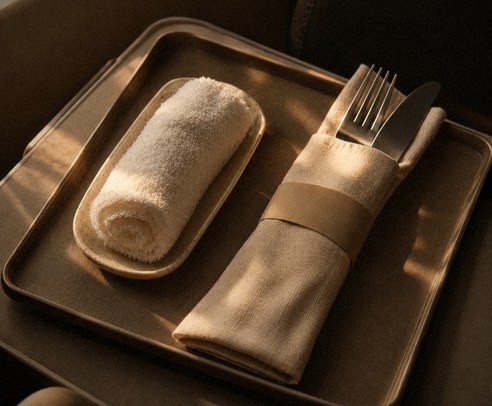
- Hot and cold towels: service towels defined by fabric, size, weight, preparation method and hygiene process.
- Food-service containers, bowls and trays: materials, dimensions, lids and packing formats matched to the operator’s catering workflow.
- Cutlery and utensils: reusable or single-use configurations, selected against the service model and applicable requirements.
- Pillow covers and guest textiles: fabric, finish, size, durability, packing and cleaning or replacement approach.
- Branded presentation: custom wrapping and packs that must balance appearance with storage, handling and waste considerations.
These are overlapping product categories, not interchangeable finished products. A cruise dining venue may favor durable reusable serviceware while an airline catering operation may require lightweight, precisely packed items. Conversely, a cruise cabin amenity may prioritize room presentation and laundering. Buyers should define use cases before choosing a material or format.
What changes between airline procurement and cruise procurement?
Space, service speed and handling
Aircraft operations are shaped by limited galley space, catering carts, crew handling and tight service schedules. In cruise hospitality, items may move through storerooms, dining venues, housekeeping and cabin-service operations. A product that fits an airline trolley may be unnecessarily small or awkward for a shipboard buffet, while a bulky resort-style pack may be impractical in aircraft service.
Voyage length and replenishment
Airline catering arrangements are coordinated around flights and airport operations. Cruise purchasing also needs to account for voyage duration, onboard storage capacity, pack counts and delivery arrangements at designated ports or distribution points. Ask how goods will be received, checked, stored and replenished, and what happens if a scheduled delivery window changes. These are purchasing questions, not claims that any particular manufacturer already offers port delivery.
Hygiene and sanitation
Cruise vessels have extensive food-service and public-space sanitation responsibilities. The US Centers for Disease Control and Prevention (CDC) Vessel Sanitation Program examines food safety and cleaning practices on cruise ships within its jurisdiction. This is a relevant public-health reference for operators with applicable US port itineraries, not a universal certification requirement for every ship worldwide. [2][6]
How should buyers specify each product category?
Wet wipes and hot or cold towels
Define wipe dimensions, fiber or material, moisture level, ingredients as applicable, fragrance preference, seal performance, printing, shelf life if relevant, and units per carton. For towels, specify fabric or substrate, weight, absorbency, dimensions, preparation, presentation and expected use. Test whether passengers or guests can open and handle the item comfortably. Confirm any relevant cosmetic, hygiene or other legal classification with the supplier for the destination market.
Aluminium food containers and cutlery
Specify container capacity, dimensions, gauge, lid compatibility, stacking, sharp-edge tolerances and suitability for the intended heating or serving method. Record whether cutlery is reusable or disposable, how it is packed and what happens after service. For products placed on the EU market and intended to contact food, the European Commission identifies Regulation (EC) No 1935/2004 as the general framework, along with applicable material-specific rules. Never infer compliance merely because an item is already used in another sector. [5]
Pillow covers and guest amenities
Specify fabric composition, dimensions, closure, seam finish, presentation and cleaning cycle assumptions. On cruise ships, test textile performance against the vessel’s housekeeping and laundering model; for aviation, check compatibility with the onboard product kit and cleaning arrangements. Custom branding should be evaluated against production quantity, packing format and the guest experience.
Which sanitation and environmental considerations matter?
Waste management is an important distinction between flying and cruising. IATA describes airline cabin waste as including cleaning and catering waste, and notes that international catering waste requirements can limit recovery and recycling on some routes. Airlines should evaluate materials and packaging against the destinations where they operate. [1]
For ships, the International Maritime Organization (IMO) explains that MARPOL Annex V generally prohibits discharging garbage at sea, with limited specified exceptions. Shipboard garbage handling and the availability of port reception facilities therefore matter when choosing disposable items and packaging. A buyer should not assume an item labeled “biodegradable” may be discarded overboard. [3]
Cruise Lines International Association (CLIA) reports that its oceangoing members seek to reduce non-essential single-use plastics and consider purchasing, recycling and packaging as part of environmental stewardship. These are industry-member commitments, not proof of what every cruise operator requires. Buyers should obtain the vessel operator’s own purchasing and environmental specifications. [4]
The practical lesson is to request evidence that is relevant to the actual use and disposal system. A simple material swap does not automatically deliver a lower environmental impact, especially when the service life, cleaning requirements, transport and end-of-life options differ between air and sea.
What should go into a sourcing brief for either sector?
A comparable quote starts with a clear brief. Procurement teams can use a common specification template, then include sector-specific fields for aircraft or cruise use. At minimum, request:
- Intended use: inflight meal service, cruise dining, guest cabin, housekeeping or another defined application.
- Product specification: material, dimensions, capacity or weight, finish, and artwork requirements.
- Performance standard: sample acceptance criteria and the specific test environment.
- Documentation: relevant food-contact, material, hygiene or labeling information for the intended destination and use.
- Packing and logistics: units per inner pack and carton, carton size, palletization and planned delivery point.
- Commercial details: minimum order quantities, tooling or print charges, price validity, lead times and change control.
- Environmental requirements: packaging restrictions, reusability expectations and the operator’s actual waste-handling process.
The question is not whether a product can travel by air or sea. It is whether its specification works for the people, service and operating conditions on board.
Can an aviation-experienced supplier support cruise ships?
Potentially, yes. A manufacturer familiar with controlled product specifications, guest-facing presentation, bulk packing and repeatable production for airline service may have capabilities worth evaluating for cruise hospitality. However, this experience does not establish a cruise supplier track record, vessel-specific approval or the ability to meet port provisioning requirements. Those must be checked for each project.
A cruise buyer should ask whether the manufacturer can adapt materials, sizes and branding; provide an appropriate sample and documentation pack; accommodate required quantities; and agree to the operator’s delivery arrangements. The product should be approved for the cruise use case on its own merits.
How should procurement teams test samples?
Start with a small trial that mirrors the real service. Ask the people who handle the product to review it: airline cabin and catering teams for an inflight item, or cruise hotel operations, food-and-beverage, housekeeping and procurement teams for shipboard items. Use one scorecard for appearance and quality, plus separate checks for each environment.
- Fit: does the item work in the intended cart, tray, storage location or cabin layout?
- Use: can staff handle, open, distribute, clean or replace it as intended?
- Durability: does the product meet performance expectations over its actual use cycle?
- Presentation: is the look consistent with the operator’s guest experience?
- Documentation and waste: have the relevant use, compliance and disposal questions been resolved?
Approve a physical reference sample and a written specification together. If artwork, materials, dimensions or packing change after approval, treat that as a new evaluation point rather than an automatic equivalent.
How SOURCED & CO. supports the sourcing discussion
SOURCED & CO.’s are capable to a supply partner with a track record serving the inflight operation of a major international airline. Its product categories include wet wipes, hot and cold towels, aluminium containers and trays, cutlery, pillow covers and guest amenities. The company coordinates product requirements, supplier selection, samples, quotation and production communication through selected partners.
For a cruise operator, these capabilities provide a relevant starting point for a sourcing enquiry, subject to evaluation of the requested product specification, applicable documentation, volumes and logistics. SOURCED & CO. does not claim in this article that its suppliers currently serve cruise lines or that products are pre-approved for maritime use.
Frequently asked buyer questions
Can airline wet wipes and hot towels also be used on cruise ships?
They may be suitable for some shipboard guest-service uses, but the cruise operator should approve the specification, packaging, hygiene expectations and any applicable documentation independently.
What do airlines and cruise lines buy in common?
Potentially overlapping categories include wet wipes, guest-service towels, food-service containers, cutlery, pillow covers and branded amenities. Exact materials and configurations may differ.
What is different about sourcing for cruise ships?
Buyers need to consider longer voyages, shipboard storage and housekeeping processes, planned port replenishment, vessel-specific food-service and sanitation requirements, and maritime waste handling.
What documentation should buyers request for onboard consumables?
Start with product specifications and physical samples. Depending on the item and destination, request appropriate food-contact, hygiene, material, labeling and packaging information, along with commercial terms and shipping details.
Does an airline supplier automatically qualify as a cruise supplier?
No. Relevant airline experience can demonstrate capabilities worth examining, but cruise suitability, operator approval, delivery planning and any maritime-specific requirements must be assessed separately.
Sources and further reading
- International Air Transport Association (IATA). Sustainable Cabin: airline cabin and catering waste management. View source
- US Centers for Disease Control and Prevention (CDC). Vessel Sanitation Program: our role on cruise ships. View source
- International Maritime Organization (IMO). Prevention of Pollution by Garbage from Ships: MARPOL Annex V. View source
- Cruise Lines International Association (CLIA). Environmental Protection and Stewardship, including plastics policies. View source
- European Commission. Food contact materials: legislation and safety framework. View source
- CDC Vessel Sanitation Program. Public health operational inspections and scope. View source
- SOURCED & CO. Corporate Capabilities
Editorial note: External sources support technical and market context; they do not independently certify SOURCED & CO. or its partners.
- Cruise ship procurement
- Aviation procurement
- Onboard amenities
- Hospitality consumables
- Maritime hospitality
- Supplier evaluation